

When accountability becomes an obsession
Why well-intentioned transparency can sometimes undermine decision-making
When accountability becomes an obsession
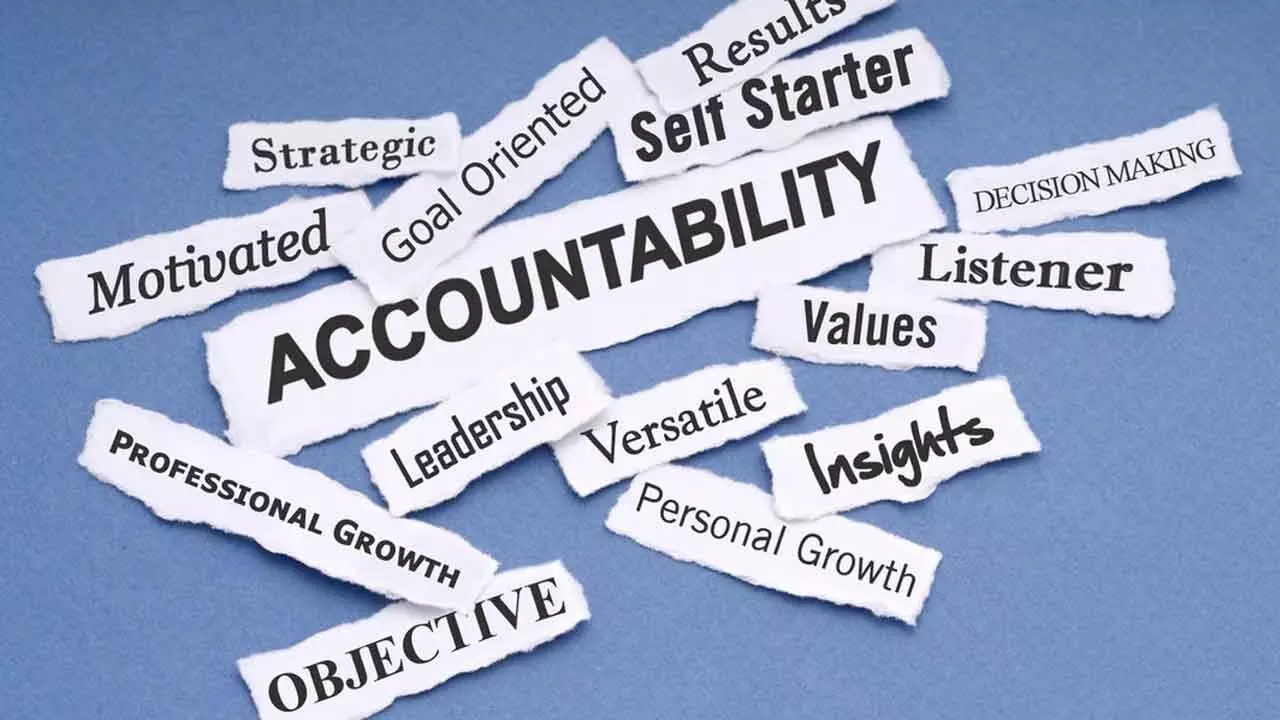

The growing emphasis on the importance and need for accountability and transparency in the sphere of public affairs is indeed a most welcome development. But, as in the case of many good things such as water, food or clean air or, on the contrary, things that are potentially harmful, such as an overdose of medication, the danger of taking such imperatives to extremes also needs to be kept in mind.
Take, for instance, the interventions these days when the Houses are in session. Members of Parliament and Legislatures are no longer addressing the issues under discussion in those fora. Instead, both in appearance and in content, the emphasis of their speeches is clearly on impressing voters in their constituencies. The ambience is being dictated by a different narrative, one of posturing, thanks to transparency being overly practised.
An episode from my days as a Joint Secretary in the Department of Agriculture and Cooperation (DOAC) in the Ministry of Agriculture, Government of India, serves as a telling illustration of the pitfalls of excessive emphasis on accountability.
Making the annual forecast for food production was an important function of the DOAC, a responsibility entrusted to the Economic and Statistical Adviser (ESA). Secretary of the department Kamal Pande and I discussed with Dr G.S. Ram, the then ESA, the desirability of altering the structure of the methodology followed in making the forecast.
The existing practice was to consolidate estimates obtained periodically from various States and Union Territories. These primary estimates were generated by the economics and statistics departments of the States and UTs, based on harvesting experiments for different crops in the Kharif and Rabi seasons. I felt this approach could be substantially refined by infusing modern tools such as econometrics and crop modelling. Dr Ram was reluctant to embark upon what he felt was needless tinkering with a method that had proved adequate until then. On my insistence, the Secretary prevailed upon the ESA to adopt the new approach.
A forecast was accordingly produced, showing a likely deficit of about three million tonnes of wheat compared with the known requirement. This was brought to the notice of the Ministry of Food and placed before the Union Cabinet, which decided to import the said quantity. The responsibility was entrusted to the Ministry of Commerce, which in turn gave the job to the State Trading Corporation of India (STC). An Argentinian private company won the tenders floated by STC.
The wheat supplied, however, was found, upon inspection at the time of import, to be infected by a pest. Most of the northern and western regions of the country are wheat-producing areas, while wheat is not widely consumed in the south or east. It was therefore decided not to discharge the wheat into the market. As a result, it lay in godowns at the port of import. Over time, the wheat began to rot.
The issue was raised in Parliament and, not surprisingly, an inquiry was ordered to be conducted by the Central Bureau of Investigation. The first question the investigating agency asked upon commencement of the inquiry was the identity of the person or agency that had put out the estimate in the first place.
Not only was Dr Ram placed in a potentially difficult situation, but it was I who had landed him there. While nothing untoward eventually ensued, the relative safety of consolidating a large number of reports from various sources—as against the application of individual expertise—was brought out vividly.
There is a feeling, especially in the middle rungs of the administration, that accountability is transiting from being a requirement to becoming an obsession. While it is a most desirable and forward-looking step, the new ethic of accountability following the enactment of the Right to Information Act has also brought with it the need to ensure that the ability to perform is not unduly compromised by apprehensions arising from a raised bar of accountability. Accountability and transparency cannot be seen in isolation; they are subject to situational imperatives.
As in many other areas of public administration, two compulsions—both equally important—must be harmonised: the freedom to act in good faith without fear of being needlessly faulted, and the need to remain accountable for one’s actions. Failing this, the integrity of the ambience pervading the apparatus of governance can be adversely impacted, sowing doubt and hesitation among those tasked with sensitive functions requiring discretion and analytical judgement.
As in Zeno’s paradox, it is possible to get paralysed into inaction by contemplating the infinite number of steps ahead. In real life, however, the important thing is to take the first step.
The imperatives of excellence in performance and compliance with demands for accountability can, at times, work at cross purposes.
Many years later, in 2004, when I was Chief Secretary to the Government of Andhra Pradesh and Dr Y.S. Rajasekhar Reddy was Chief Minister, he once asked me why a certain matter on my desk was being delayed. Slightly cheesed off, I told him that I was mentally arriving at a formulation of my recommendation in a manner that could withstand scrutiny by agencies such as the Supreme Court of India, the CBI or Parliament years later. After all, it would be I, not he, who would be called upon to defend the government in the matter. He understood and left it at that. Another illustration of how an overdose of accountability can induce sloth, if not total inaction. Leaders, whether in public life or in spheres such as the corporate sector, academia, scientific institutions or even sports, must command respect. But this should be achieved by creating caution, not panic. The objective must be to foster efficiency, competence and prudence, not paralysis.
In the same year, during the Pushkaram celebrations of the Krishna River, a fatal accident resulted in the deaths of several persons. I quoted Julius Caesar in a letter to the Chief Minister offering to resign, accepting accountability for the incident, though neither I nor the administration I headed was responsible.
On transparency in public affairs, I recall another oft-quoted episode involving Caesar. When a man named Clodius was accused of sneaking into a women-only religious ritual held in Caesar’s palace and hosted by his wife Pompeia, Caesar divorced her despite believing she was innocent, famously stating that his wife ought not even to be under suspicion. While not believing that his wife was unfaithful, Caesar still divorced her, famously stating, “My wife ought not to even to be under suspicion”, to maintain his public reputation.
The need for transparency was perhaps best articulated by Lord Hewart in 1924, when he wrote: “Justice must not only be done, but must also be seen to be done.”
Have you ever attended a South Indian wedding, especially in rural areas? The fare is extraordinary, dal, curries, chutneys, sambar, rasam, pickles, curd rice, papads, vadas and vadis, apart from a variety of sweets. So delicious is the meal that it is difficult to stop eating.
Not very different is the experience of sharing a meal at the Nizam Club in Hyderabad, where the Mughlai dishes give you an unforgettable treat. It is only when one visits the open areas where rural wedding meals are prepared, or the kitchens of such clubs, that one may feel momentarily put off, despite all the emphasis on cleanliness, gloves, headgear and hygiene.
Another argument, perhaps, against excessive transparency.
(The writer was formerly Chief Secretary, Government of Andhra Pradesh)





